Knowledge management & practical systems
Local ChatGPT export & knowledge system
Turning scattered conversations and attachments into a searchable local archive, with a clear boundary between source material and reviewed knowledge.
Problem definition, product requirements, workflow direction, testing and refinement; AI-assisted implementation
Inside this case study 6 sections
The opportunity
Useful research, decisions and project work were accumulating in ChatGPT conversations, but recovering them meant navigating large exports and disconnected attachments. I wanted an archive I could actually use, rather than another folder of files.
The result is a working local system that organises exports by account, makes individual conversations readable and searchable, and keeps their attachments connected to the original discussion.
My contribution
I identified the problem, defined the requirements and shaped the product workflow, then tested and refined the system against real exports. I directed how the archive should support finding and reusing past work while preserving the original conversations and attachments as context.
Codex helped design implementation details and wrote substantial portions of the code under my direction. My contribution centred on product decisions, practical testing, identifying issues and steering improvements.
From export to usable archive
- Import and separate. Bring exported conversations into distinct account archives rather than merging unrelated sources.
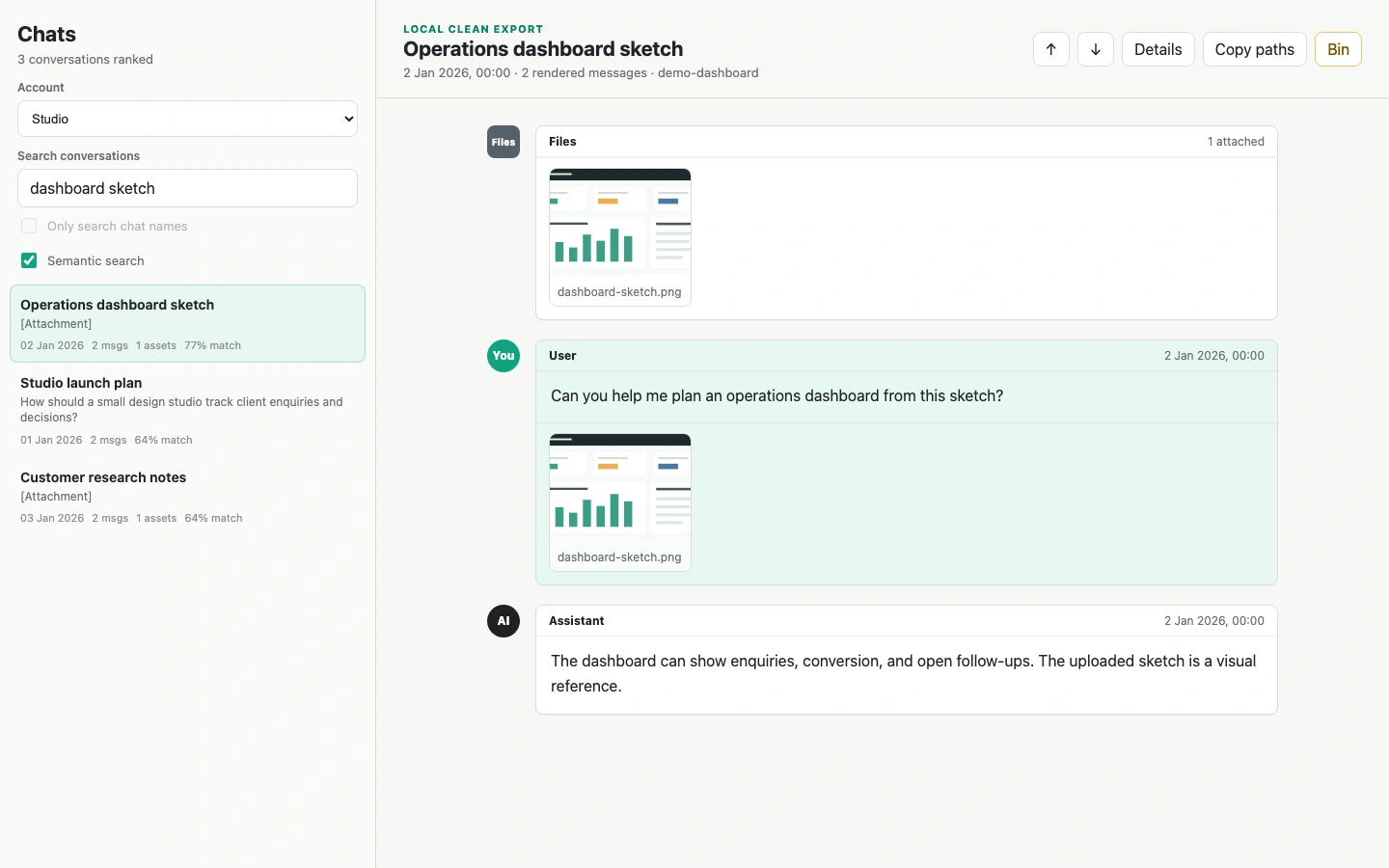
- Make the source readable. Preserve individual JSON records and generate Markdown transcripts.
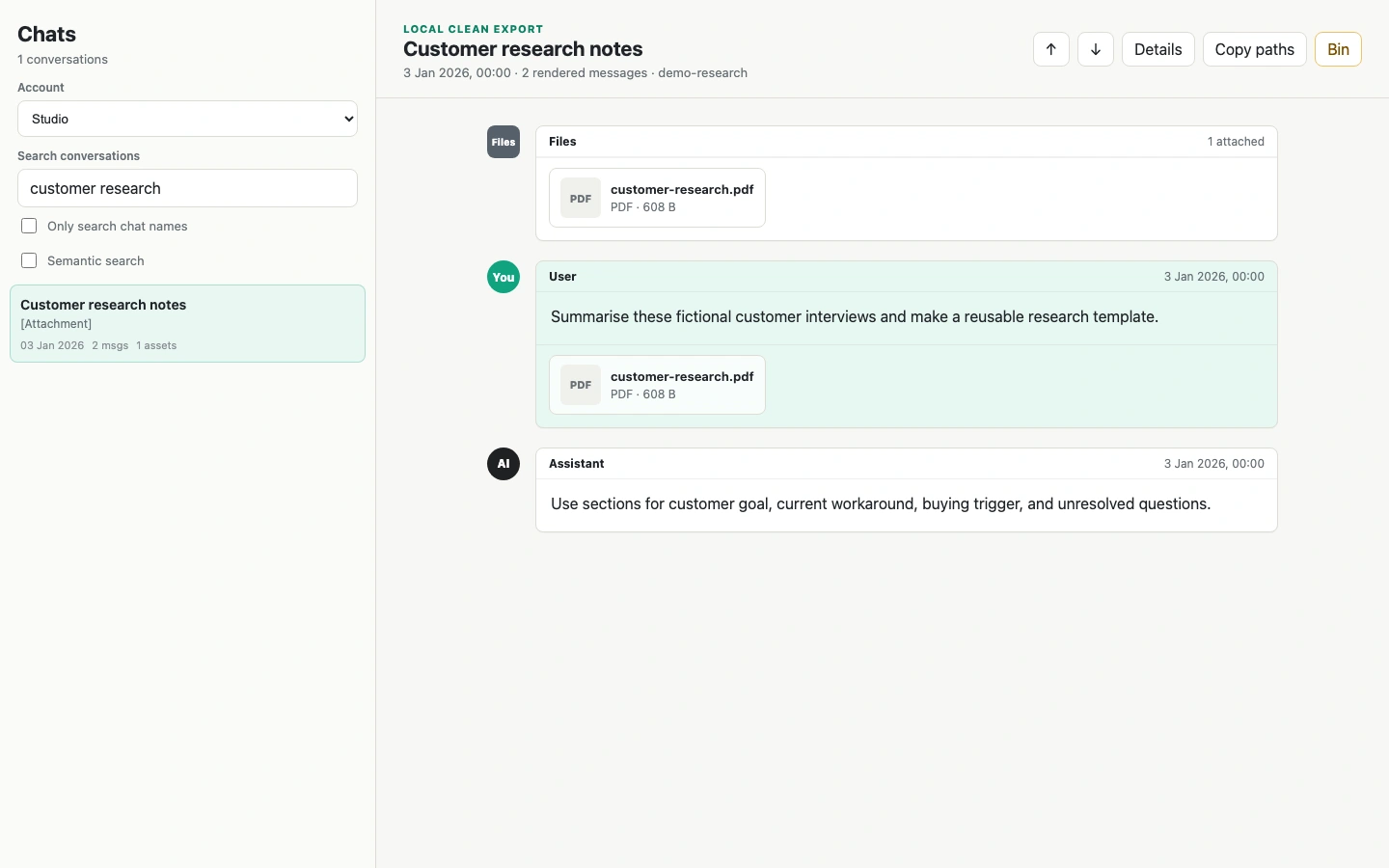
- Reconnect the evidence. Restore common attachment file types and link files back to their conversations.
- Find the relevant work. Use searchable indexes and a local chat-style viewer, with optional semantic search.
- Reuse with context. Return to the original discussion and supporting files before extracting a conclusion or making a claim.
Keeping attachments with their context
Product decisions
Local storage and separate accounts
The archive is designed around local files and separate account spaces. That makes source organisation explicit and avoids treating several exports as one undifferentiated history.
Search without losing provenance
Search helps locate a conversation; the original chat and attachments provide the context. Semantic search is an optional retrieval aid, not a guarantee that every relevant detail will be found.
An archive is not automatically a knowledge base
The viewer and the evidence-first knowledge workflow are separate. The archive preserves source material. Turning that material into reusable knowledge requires review, source links and a clear distinction between supported claims and claims awaiting verification.
Practical outcome
I have a working local archive that makes past conversations and associated files easier to find and reuse. The public source repository includes a synthetic example generator so the workflow can be demonstrated without exposing personal material.
Explore the public project repository
Evidence boundaries
The screenshots demonstrate the viewer using fictional accounts and conversations. They do not expose my private archive or establish a measured time saving. Semantic search ranks whole chats and can miss a detail inside a long conversation. Local storage still requires careful handling of sensitive exports; it is not a claim that every use of the system is automatically private or secure.