Academic project · Financial analysis · 2025-26 academic year
ReLeaf - financial modelling & business decisions
An Excel-based academic analysis of a fictional business case, connecting costs, profitability and cash planning with decisions about allocating scarce resources.
Excel-based Accounting and Finance coursework using a supplied business case and workbook template
Inside this case study 6 sections
The business questions
The ReLeaf case provided a way to connect accounting calculations to operating decisions: how sales affect profitability, how much activity is needed to break even, how cash and working capital should be planned, and which products to prioritise when a resource is limited.
This was Excel-based Accounting and Finance coursework using a supplied fictional business case and workbook template. The model figures below are academic case outputs, not revenue or profit from a business I operated.
My contribution
I used Excel to connect financial analysis with business decisions, working across budgeting, profitability, cash flow, break-even, working-capital analysis, scenarios and constrained-resource decisions as part of my Accounting and Finance coursework.
The case and workbook structure were supplied for the assessment. My work applied those financial concepts within the template, using its linked views to examine profitability, planning assumptions and resource priorities.
Costs, contribution and sales scenarios
The selected cost model links a £75 selling price with £42 variable cost per unit, giving £33 contribution per unit. It then compares worst-case, expected and best-case sales against the same fixed-cost assumptions.
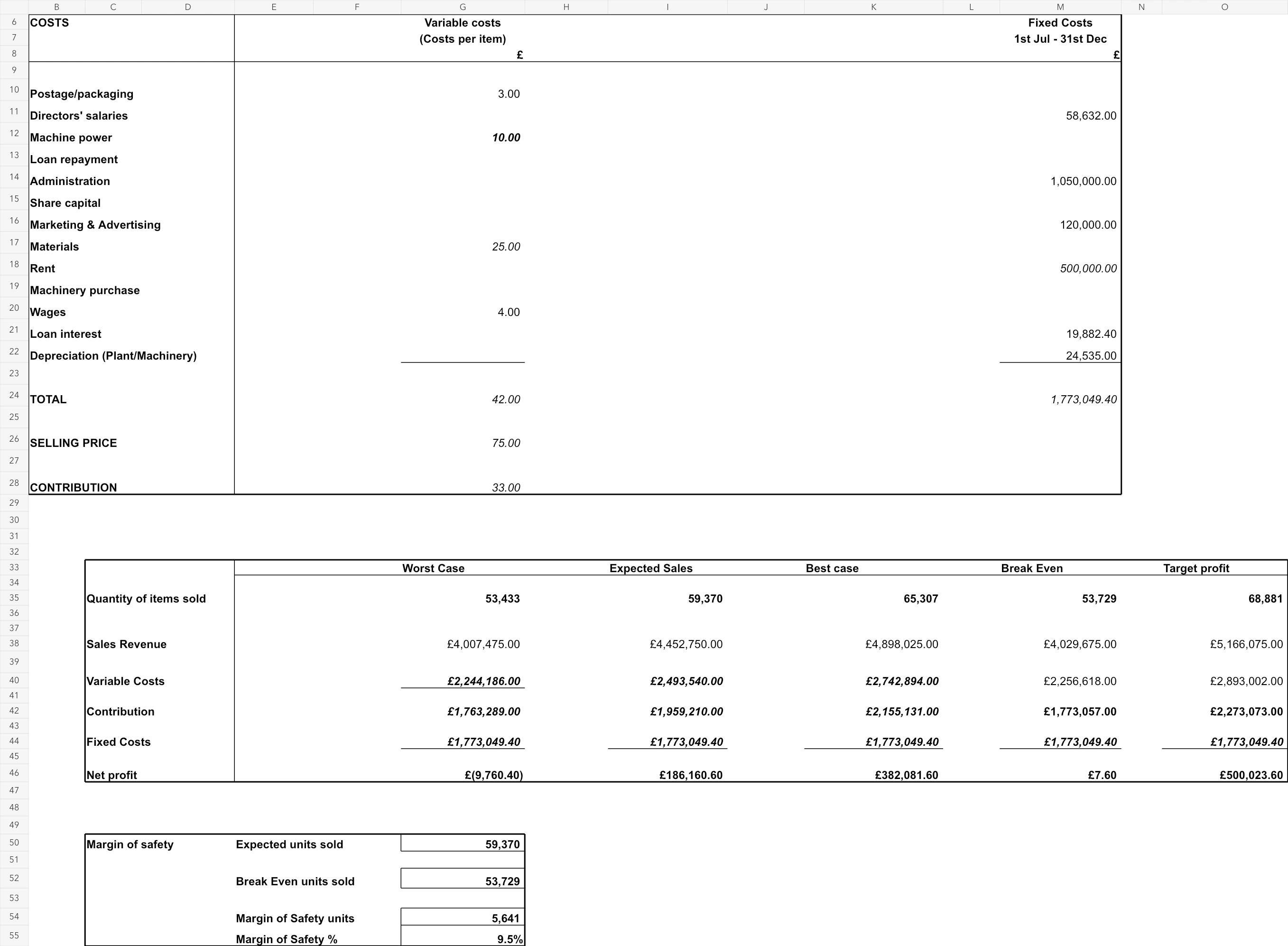
The model shows break-even at 53,729 units, against expected sales of 59,370 units, with a displayed margin of safety of 9.5%. The margin of safety shows how far sales could fall below the expected case before reaching break-even.
A scarce-resource decision
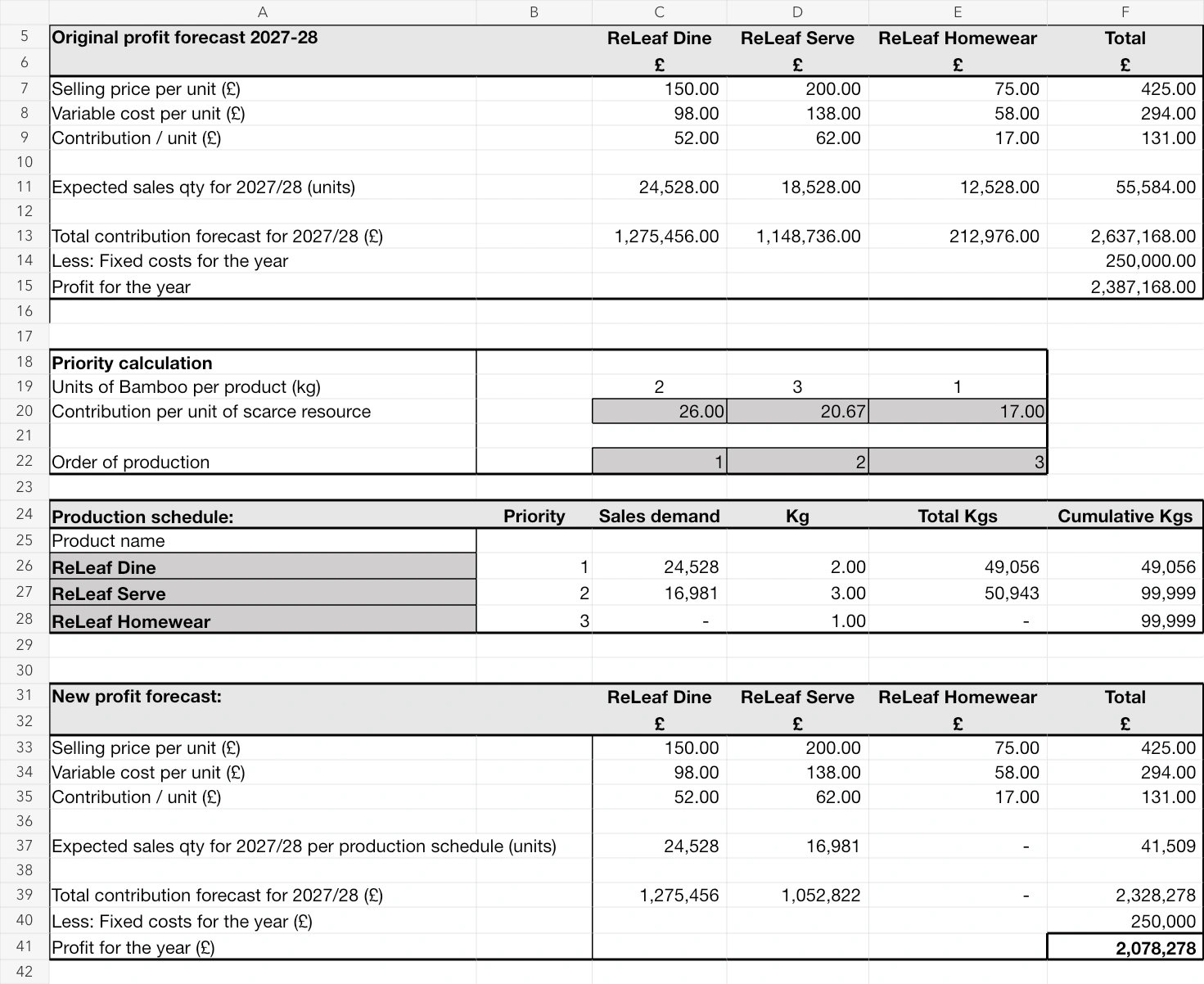
For the product mix, the limiting resource is bamboo. The model compares contribution per kilogram rather than contribution per finished unit.
| Product | Contribution per unit | Bamboo per unit | Contribution per kilogram | Priority |
|---|---|---|---|---|
| ReLeaf Dine | £52 | 2 kg | £26.00 | 1 |
| ReLeaf Serve | £62 | 3 kg | £20.67 | 2 |
| ReLeaf Homewear | £17 | 1 kg | £17.00 | 3 |
Serve has the highest contribution per item, but Dine gives the highest contribution per kilogram of the constrained material. Under the case assumptions, that changes the production priority.
The wider financial picture
The coursework also covered working-capital and cash budgets. Together with the profitability and scenario work, those views address different questions: a profitable forecast does not by itself explain when cash is available or how operating requirements will be funded.
The selected extracts show the reasoning behind the model outputs without reproducing every worksheet. Full-size views are available by opening each image.
Evidence boundaries
The figures are drawn from a supplied academic case and the saved coursework workbook, not an independently audited financial model or real business results. Only selected privacy-safe extracts are shown, rather than the original macro-enabled workbook.